
Persephone: The Queen of Two Realms and the Wisdom of Transformation

In the vast and dramatic tapestry of Greek mythology, few figures embody the duality of existence as profoundly and poignantly as Persephone. She is the Maiden of Spring, the Kore, whose smile makes the flowers bloom and whose touch brings the warmth of new life. But she is also, and perhaps more powerfully, Persephone, the feared and revered Queen of the Underworld, consort to Hades, who knows the deepest secrets of darkness and guides souls on their final journey. Her story is not merely a tale about the origin of the seasons; it is an epic allegory about the loss of innocence, the confrontation with trauma, the discovery of personal power in darkness, and the integration of light and shadow into a wise and complete whole. She is the living bridge between the world above and the one below, the goddess who dies and is reborn each year, teaching us that life and death are not opposites, but inseparable partners in the dance of existence.
For modern pagans and spiritual seekers, Persephone offers one of the richest and most psychologically resonant archetypes. She is the guide for our own inner descent, the proof that one can journey through our personal underworld—our sorrows, fears, and traumas—and return not diminished, but strengthened, with a wisdom that only darkness can bestow. This article will trace Persephone's journey, from her golden youth as Kore to her ascension as the somber sovereign of Hades. We will explore her central mythology, her crucial role in the sacred Eleusinian Mysteries, her worship in antiquity, and her vibrant relevance today. Finally, we will detail her many associations—symbols, plants, stones, and practices—that allow us to connect with her transformative energy, honoring both the flower she was and the throne she came to occupy.
The Mythology of Persephone: The Descent and the Coronation
The story of Persephone is, at its core, the story of a forced transformation that becomes a source of unparalleled power. Its main sources are the Homeric Hymn to Demeter, as well as the works of Hesiod and Ovid.
Kore, the Maiden of Flowers
Initially, she was known primarily as Kore, which simply means "the maiden" or "the daughter." She was the beloved and only daughter of Demeter, the goddess of agriculture, harvests, and the earth's fertility, and of Zeus, the king of the gods. Kore lived an idyllic existence, personifying the joy and purity of spring. She spent her days in green fields, often in Sicily or on the plains of Nysa, gathering flowers in the company of the Oceanid nymphs. She was the very essence of new life, of blooming, and the promise of summer.
However, her radiant beauty did not go unnoticed. From his shadowy throne in the realm of the dead, Hades, her uncle and brother to Zeus and Demeter, watched her and desired her for himself as his bride and queen. Knowing that Demeter would never willingly consent to see her luminous daughter descend into darkness, Hades went directly to Zeus. Zeus, in a decision that would seal the fate of his daughter and the world, gave his secret consent, allowing Hades to abduct the young goddess.
The Abduction and the Cry that Shook the World
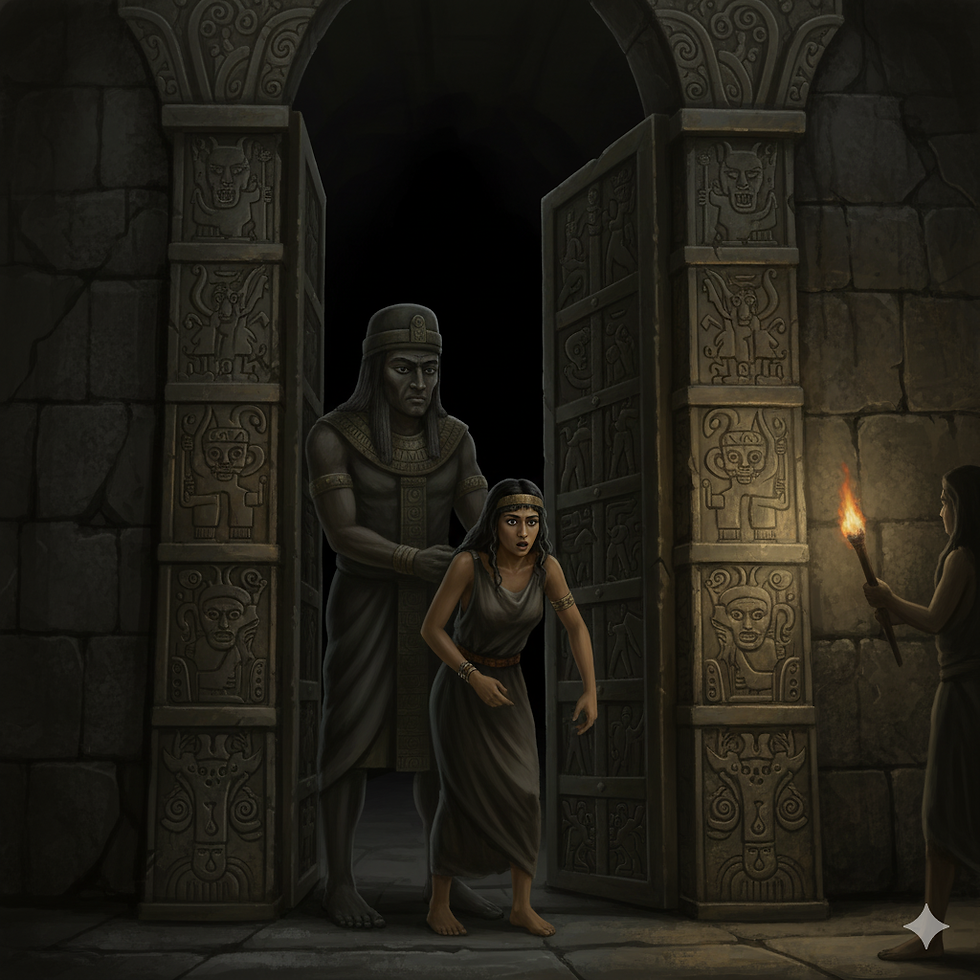
One day, as Kore was gathering flowers with her companions, the earth (Gaia), by Zeus's command, produced a flower of extraordinary and irresistible beauty: a narcissus with a hundred blossoms, whose fragrance enchanted the sky, the earth, and the sea. Lured by this marvel, Kore strayed from her friends to pick it. The moment her hands touched the flower, the earth split open into a dark, deep chasm. From it emerged Hades in his golden chariot drawn by black, immortal horses. He seized the terrified maiden and carried her, screaming, into the depths of his realm, the underworld.
Her cry of despair was the last sound heard from her in the world above. Only two deities heard it clearly: Hecate, the goddess of magic and crossroads, from her cave, and Helios, the all-seeing sun god, from his celestial chariot. Her mother, Demeter, heard only the echo of the cry and felt a sharp pain in her heart, not knowing what had happened. The earth closed up without a trace.

Demeter's Search and the World's Winter
Heartbroken with anguish, Demeter began a desperate search for her daughter. For nine days and nine nights, she wandered the earth, without eating, drinking, or bathing, carrying a lit torch in each hand, searching for any sign of Kore. But no one, neither gods nor mortals, would tell her the truth. Her sorrow was so profound that the earth itself began to suffer with her. As the goddess of agriculture, her grief caused all fertility to withdraw from the world. Seeds would not sprout, plants withered, animals did not reproduce, and famine began to plague humanity. The world plunged into a perpetual winter.
On the tenth day, Demeter met Hecate, who led her to Helios. The sun god, who sees all that happens on earth, revealed the truth to her: that Zeus had given her daughter to Hades to be his bride.
Betrayed by her own brother and king, Demeter's grief turned to fury. She abandoned Olympus and her divine duties, disguising herself as an old mortal woman named Doso. On her journey, she came to the city of Eleusis, where she sat by a well, the Maiden Well. There she was found by the daughters of King Celeus, who took her to the palace to be the nursemaid for their infant brother, Demophon. In secret, Demeter attempted to make the boy immortal by anointing him with ambrosia and placing him in the fire each night to burn away his mortality. But his mother, Metanira, discovered the ritual and screamed in terror, breaking the spell. Demeter, enraged, revealed her true identity and demanded that the people of Eleusis build a great temple in her honor. It was in this temple that she secluded herself, away from the other gods, deepening her grief and the devastation of the world.
The Agreement and the Pomegranate Seeds
Seeing that humanity was on the verge of total annihilation by famine, which would mean the end of offerings to the gods, Zeus finally realized the gravity of the situation. He sent various gods, one after another, to try to persuade Demeter to return and restore the earth's fertility, but she refused to yield until her daughter was returned to her.
With no other option, Zeus sent the messenger Hermes to the underworld with the order for Hades to release Persephone. Hades, knowing he could not directly defy a decree from Zeus, agreed to obey. He approached his queen, who was sitting beside him, sad and missing her mother, and told her gently that she could return to the world above.
However, before letting her go, the cunning lord of the underworld offered her something to eat: pomegranate seeds. Knowing she was about to be freed, but perhaps hungry after so long or simply yielding to a final gesture from her captor, Persephone ate some of the seeds (the number varies in the myths—three, four, six, or seven). What she did not know, or perhaps learned too late, was that there was an ancient, unbreakable law: whoever consumed any food or drink in the underworld would be forever bound to it.
When Persephone emerged from the underworld and was reunited with her mother in a moment of ecstatic joy, Demeter immediately asked her if she had eaten anything. With a heavy heart, Persephone confessed to eating the pomegranate seeds. Her fate was sealed. Because of this, she could not remain in the world above for the entire year.
A final agreement was mediated, often by the mother of the gods, Rhea. Persephone would spend part of the year in the underworld with her husband, Hades (corresponding to the winter months, when Demeter grieves and the earth lies barren), and the other part in the world above with her mother (corresponding to spring and summer, when Demeter's joy makes the earth flourish again). Thus, Persephone's cycle became the cycle of the seasons, a perpetual reminder of her journey between the two realms.
The Queen of Two Faces: Kore and Persephone
The essence of Persephone lies in her duality. She is not just one or the other; she is both, integrated.
Kore, the Maiden of Spring: This is her aspect of light. It represents innocence, youth, unrealized potential, carefree joy, the beauty of nature in bloom. It is the seed that has not yet sprouted, the promise of life. However, this innocence also makes her vulnerable, the archetype of the "daughter" who is defined by her relationship with her mother, not yet having a fully formed identity of her own.
Persephone, the Queen of the Underworld: This is her face of shadow and power. Her descent, though traumatic, was an initiation. In the underworld, she ceased to be merely the "daughter of" and became a sovereign in her own right. She is feared and respected, not only by mortals but also by the gods. She is the only one who truly knows both worlds. This aspect represents the wisdom gained through pain, authority, knowledge of hidden mysteries, the ability to navigate darkness, and the understanding of the cycle of death and rebirth. She is not a reluctant prisoner; she is the Queen who rules alongside her King, with power and dignity.
Her story is one of integration. The maiden Kore does not die so that Queen Persephone can live. Instead, Queen Persephone carries within her the memory and essence of the maiden, and the maiden, when she returns to the light, brings with her the wisdom and depth of the underworld. She teaches that our wholeness comes not from rejecting our darkness or our lost innocence, but from integrating all parts of our experience.

Persephone and the Eleusinian Mysteries
The importance of Persephone in ancient Greek religion cannot be overstated, largely due to her central role in the Eleusinian Mysteries. These were secret initiation rites held annually at the temple of Demeter in Eleusis, and were considered the most important of all the mysteries in ancient Greece.
The Core of the Myth: The sacred drama of the Mysteries represented the story of Persephone's descent, Demeter's search, and their final reunion. The initiates (called mystai) participated in rituals that allowed them to symbolically experience this journey.
The Promise of an Afterlife: Unlike the public Greek religion, which offered a rather bleak view of the afterlife (a shadowy, meaningless existence in the realm of Hades), the Eleusinian Mysteries offered its initiates hope. By witnessing and participating in Persephone's cycle of death and rebirth, the mystai lost their fear of death. The promise was not of immortality, but of a significantly better afterlife and a deeper understanding of the cosmic order.
Symbols and Rituals: The exact rituals are unknown, as initiates took an oath of secrecy on pain of death. However, we know they involved purifications, processions, the drinking of a sacred beverage called the kykeon, and a climax in a dark hall (the Telesterion), where the initiates witnessed "things said, things done, and things shown." Persephone, as the one who travels between the two worlds, was the key to this revelation. She was the living proof that one can descend into darkness and return, transformed and with a new understanding of life.
Modern Relevance: The Guide for the Soul's Journey
Today, Persephone is one of the most beloved and sought-after deities in modern pagan paths, psychology, and feminine spirituality.
Goddess of Shadow Work: Persephone is the perfect guide for shadow work. She does not just rule the darkness, like Ereshkigal; she travels to and from it. She understands the fear of the descent and the joy of the return. She is invoked to give us the courage to face our traumas, fears, and repressed parts of ourselves, knowing that this journey is necessary for our wholeness.
Symbol of Survival and Resilience: Her story, seen through a modern lens, is that of a survivor of abduction and trauma. Her transformation from victim to powerful queen is an inspiring archetype for those who have gone through devastating experiences, teaching that it is possible not only to survive but to find power and sovereignty in the aftermath of trauma.
Archetype of Integration: In Jungian psychology and Goddess spirituality, her myth represents the journey of individuation. The separation from the "mother" (Demeter), the confrontation with the shadow masculine or the unconscious (Hades), and the subsequent integration of all these experiences to become a complete and sovereign being.
Guide for Transitions: As a goddess who constantly crosses boundaries, Persephone is a patroness of all forms of transition: life changes, rites of passage, the menstrual cycle, and, of course, the final transition of death.
Magical and Natural Associations of Persephone
Connecting with Persephone involves embracing her duality, honoring both her light and shadow aspects.
Symbols:
Pomegranate: Her most famous symbol. It represents the underworld, fertility, death, the indissolubility of bonds, and secret knowledge. Its many seeds in a single rind also symbolize unity in multiplicity.
Torches: A symbol of Demeter's search and the light that Hecate carries to guide Persephone out of the underworld. They represent illumination in darkness, the search for truth.
Flowers (Narcissus and Asphodel): The narcissus is the flower that lured her to her abduction, symbolizing dangerous beauty and the doorway to the underworld. The asphodel is the flower said to cover the fields of the underworld.
Keys: As Queen of the Underworld, she, along with Hades and Hecate, holds the keys that open and close the gates between worlds.
Wreath of Flowers / Garland of Grain: Symbols of her aspect as Kore, representing spring, youth, and the harvest.
Animals:
Bat: An animal of the night and caves, which navigates in darkness, making it a fitting messenger of her realm.
Serpent: A universal chthonic animal, linked to the earth, rebirth (through the shedding of skin), hidden wisdom, and the underworld.
Owl: Associated with the night, mystery, and the wisdom that comes from darkness.
Colors:
Duality: Her palette is inherently dual.
Kore Aspect (Spring): Light green, yellow, pink, white, the colors of flowers and meadows.
Persephone Aspect (Underworld): Black, dark red (pomegranate color), silver (moonlight in darkness), gold (royalty).
Herbs and Plants:
Pomegranate Tree (Punica granatum): Her most sacred plant.
Narcissus (Narcissus): Symbolizes death and rebirth, beauty and danger.
Asphodel (Asphodelus): The flower of the underworld.
Poppy (Papaver somniferum): Associated with sleep, dreams, and death (due to opium). Demeter was also associated with it to ease her pain.
Cypress (Cupressus sempervirens): A classic graveyard tree, symbolizing death and eternal life.
Willow (Salix): Linked to the moon, water, and the underworld in many traditions.
Mint (Mentha): From the myth of the nymph Minthe, who was loved by Hades and was transformed into a mint plant by a jealous Persephone, showing her fiercely protective side of her marriage.
Stones and Crystals:
Obsidian: For shadow work, protection, and revealing hidden truths.
Black Onyx / Black Tourmaline: Grounding, protection during astral travel or descent meditations.
Jet: Absorbs grief and sorrow, linked to the deep earth.
Rose Quartz / Peridot / Chrysoprase: To honor her aspect as Kore, linked to emotional healing, growth, and the joy of spring.
Garnet: The "pomegranate stone," symbolizing life, death, passion, and commitment.
Moonstone: Connection to the feminine, intuition, and cycles.
Incenses:
Myrrh: A classic incense for grief, introspection, and honoring the dead.
Cypress or Sandalwood: Earthy, resinous scents for meditation and creating an underworld atmosphere.
Florals (Narcissus, Hyacinth, Lily): To honor her return in the spring and her aspect as Kore.
Storax: A heavy base incense, often used for chthonic and underworld work.
Modern Devotional Practices
Approaching Persephone is to embrace the cycles of one's own life.
Seasonal Altar: Create an altar that changes with the seasons. In spring and summer, decorate it with fresh flowers, bright colors, grains, and crystals like rose quartz, honoring Kore. In fall and winter, switch to dark colors, pomegranates, black or red candles, obsidian, and myrrh incense, honoring Queen Persephone.
Pomegranate Ritual: In the fall, perform a ritual to mark her descent. Meditate on what you need to release or let die in your life. Eat six pomegranate seeds with intention, accepting your own inner "winter" as a time of rest and introspection.
Devotional Gardening: In the spring, plant flowers like narcissus, hyacinths, or crocuses in her honor, celebrating her return and the awakening of life.
Shadow Journal: Keep a journal dedicated to shadow work, asking Persephone to guide you. Write about your fears, your sorrows, and the parts of yourself you keep hidden.
Honoring the Ancestors: As Queen of the Dead, honoring her also involves honoring those who came before us. Create a small space for your ancestors on your altar or visit cemeteries with respect, leaving a flower in her honor.

Conclusion: The Guide Who Knows the Way Back
Persephone is, ultimately, a goddess of hope. Not a naive hope, but a hope forged in darkness and tested by suffering. Her story teaches us that descent is inevitable. We will all have moments when the earth opens beneath our feet and we are dragged into our own depths. But her myth assures us that the descent does not have to be the end. It is an initiation. It is in the underworld that the maiden becomes a queen, that the victim finds her sovereignty, and that the soul discovers its resilience.
She is the guide who not only shows us the way into the darkness but, crucially, knows the way back. She embodies the eternal cycle of life, death, and rebirth that we see in nature and feel within ourselves. By embracing Persephone, we learn not to fear our winters, but to see them as a necessary time of rest, reflection, and gestation for the spring that will inevitably return, bringing us back into the light, not as we were before, but wiser, stronger, and more whole.
To display the Widget on your site, open Blogs Products Upsell Settings Panel, then open the Dashboard & add Products to your Blog Posts. Within the Editor you will only see a preview of the Widget, the associated Products for this Post will display on your Live Site.
Start your 14 days Free Trial to activate products for more than one post.
icon above or open Settings panel.
Please click on the
Comments